Vocabulary dictionary

Kanji dictionary

Grammar dictionary

Sentence lookup

test
 

Forums - Really confused with these sentences how they change with をplacement.

Top > 日本語を勉強しましょう / Let's study Japanese! > Anything About Japanese


avatar
ntb899
Level: 26
18110a916d2ecca513492e8a.jpg

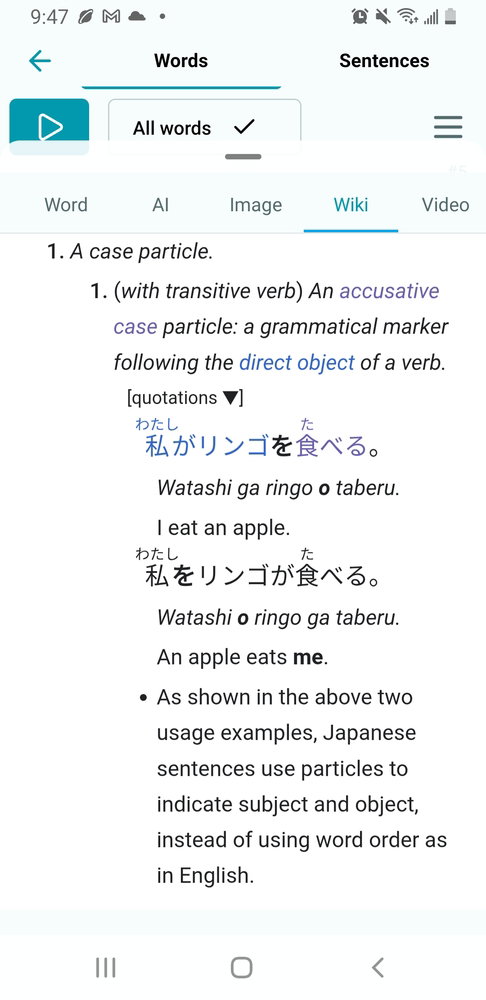
ive never really understood the idea of "direct objects" even though I'm fluent in English, so this is a bit confusing to me, I know that ga is like the subject which in the first is "I" and the second its an apple. But now my confusion is like why did the order have to change? And how do I just know that the second is saying the apple eats me if I didn't have the translation there to compare? It's a bit confusing. Why couldn't ringo ga be the start of the 2nd sentence?

2
4 days ago
avatar
Chirushii
Level: 135

The direct object in a sentence is what the verb is acting on. In English, its usually after the verb. In japanese it's marked with 'wo'. As for the order, japanese is much more flexible than English. So the example sentence reversing the ga and wo didn't change the meaning.

Watashi ga ringo wo taberu

Ringo ga watashi wo taberu

you could do it like that as well.

2
4 days ago
avatar

@Chirushii The meaning does change in that case. べる and リンゴをべる don't mean the same thing at all.

That's why I don't like these "an apple eats ME" examples some resources like to give :D

They aren't wrong, but may cause a bit of confusion.

2
4 days ago
avatar
むじな
Level: 873

Something that might make the idea of a direct object clearer is to look at verbs that can't have one, namely intransitives.

Put simply, the subject does the action and the direct object is acted upon (unlike other objects, which can be what the action is carried out through , or for, or which show how exactly it's carried out etc.). That poor apple, realistically, can only be the object, the one being eaten. If it was the subject, the one who did the eating, now that would be scary.

But some verbs are intransitive, they don't act on something, they just happen. "I told a joke and he laughed." What did I tell? A joke. That's the direct object. But what did he laugh? Huh? What do you mean, what? He just laughed. He couldn't have laughed a wall, or a bird, or a conference. (He could have laughed at them, sure, but those are not direct objects, their relation to the verb is not that close.)

Now for Japanese:

If we're playing hide-and-seek, it matters if I (subject) see you (object), so I win, or you (subject) see me (object), so you win. In English, the subject will come before the verb and the direct object will come after. There's no need for particles, their place shows us their role. Japanese is more flexible as to where parts of the sentence can sit, so it needs particles (placed after the part) to show us what role they have. If I () see you (), there will be a が after to show I'm the one doing the seeing, and a を after to show you're the one being seen. Because their position and order alone won't reliably tell us that.

Does it make a little more sense? You could also just try reading more sentences with を (including from Renshuu's dictionary's Sentences tab) to get a grip on how they work.

6
4 days ago
avatar
Shamugan
Level: 863

"Why couldn't ringo ga be the start of the 2nd sentence?"

It can :D
The point of those two examples was to demonstrate that the order of words doesn't matter as long as the particle are there.

がりんごをべる
りんごをべる

をりんごがべる
りんごがべる

The first two sentences carry the same information: =subject, りんご=object, べる=verb.
And the last two also carry the same information: =object, りんご=subject, べる=verb.

You worry about word order, Japaneses don't. At least grammaticaly. Focus on locating the particles for now because that's the important part and get used to that "flexibility". Otherwise, you will lose your mind with casual/spoken Japanese (and a lot of other thing).
Word order is interesting but only at higher level (past intermediate level imo).

PS: "ive never really understood the idea of "direct objects"", me too, that's why I completely ignored it to learn Japanese first :D. Instead, I focused on getting used to the sentences without trying to really understand them. You don't to "understand" the role of an object right now in order to "know" that "がりんごをべる" is a correct sentence whose meaning is "I eat an apple". And only after accumulating that kind of sentences was I able to talk about it a bit more. Only a tiny bit. But I also have more unresolved questions than before...
Anyway, if it doesn't make sense, just study more sentences until you get "used" to them. And later, come back to analyze them again with grammar. It's a lot easier to understand grammar once you're already "used" to the language (and know what is "correct" before trying to judge or understand it). But that's just my tips :D
Some like to start with grammar, other don't, both make tons of mistakes until their reach higher level and both may succeed too.

7
4 days ago
avatar

@Shamugan You have a slight typo in your third sentence: "がを"

Just letting you know :)

1
4 days ago
avatar
Shamugan
Level: 863

Thanks xD
Also changed a few things that were slightly different from what I wanted to say x)

1
4 days ago
avatar
ヒヨドリ
Level: 302

I think what can confuse English speakers is that Japanese particles "fuse" to what came before, while in English a particle links to the word after.

For example: I'm going to-->Tokyo vs. <--に く.

In Japanese a particle changes the grammatical function of what it attaches to. In OP's example, りんご goes from being just a noun to りんごを which is an object that a verb can act on. And goes from a simple pronoun to a subject が that can do the action.

I think it's useful to analyze a sentence not by words, like this:

... が ... りんご ... を ... べる (just a jumble of words)

but rather like this:

が ... りんごを ... べる (now it makes grammatical sense)

That way it's much more obvious who is the subject and object and how swapping をand が changes the meaning. As things become more complicated with modifiers and such, keeping this way of analyzing will help things make sense.

6
4 days ago
avatar
Shamugan
Level: 863

In Japanese, that's called a 文節 and it's the fundamental unit of Japanese grammar.
が, りんごを and べる, each of them of them are a 文節.

Other fun fact, particles are almost never studied alone. They also belong to the 付属語 category. Basically, the "dependent word category".
The JP definition of 文節 is: を、としてでないったときにられる. There are a few variations but basically, it's "The smallest unit obtained when a sentence is divided into parts that remain natural". Which I often want to translate to "The smallest unit that still makes sense" but that would be just me ranting about the way Japanese is taught x)

5
4 days ago
avatar
RCRCRC
Level: 65

If you still have a hard time understanding it after all the answers above, I suggest watching CureDolly’s video about this. (I cannot do YouTube right now so I cannot link it for you)

I think I heard "Stop thinking about Japanese in an English perspecive"... or something along those lines from her videos.

I read some of her blogs as well which is a good food for thought about creating your Japanese mindset.

It is a great loss that she is not with us anymore.

1
3 days ago
avatar
マイコー
Level: 344
If you ever get your hands on a textbook for native children (elementary school, first couple of years), or even a picture book aimed for kids, you'll often see the same word+particle pairing that is described above with spaces in between each pair.
1
3 days ago
Getting the posts


Top > 日本語を勉強しましょう / Let's study Japanese! > Anything About Japanese


Loading the list
Lv.

Sorry, there was an error on renshuu! If it's OK, please describe what you were doing. This will help us fix the issue.

Characters to show:


Use your mouse or finger to write characters in the box.
■ Katakana ■ Hiragana