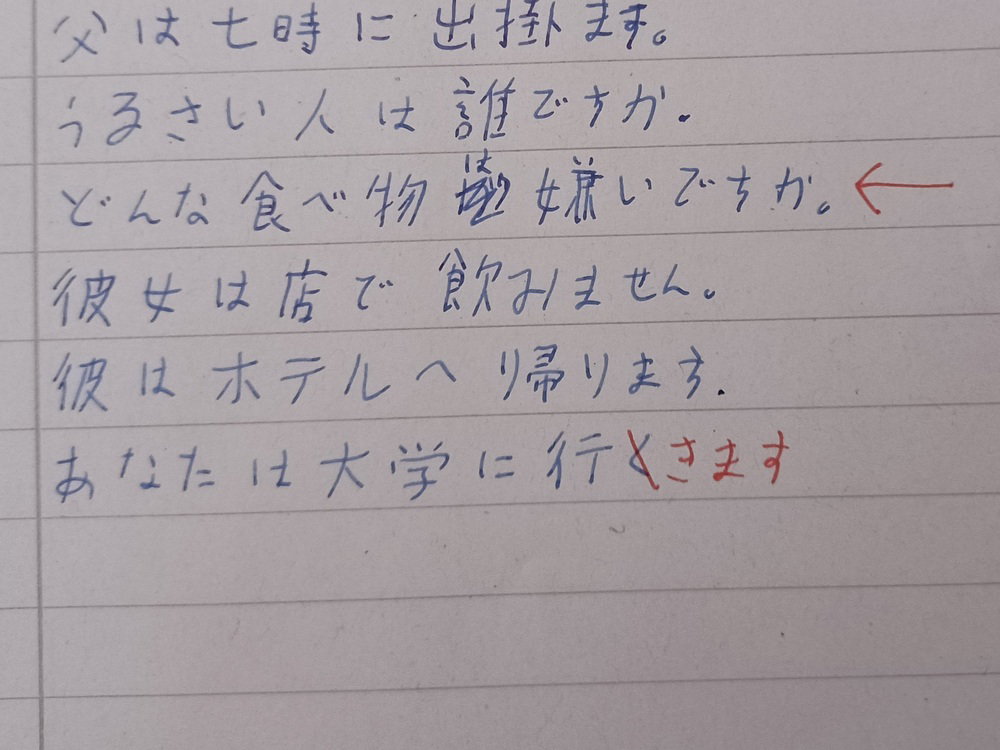
Your sentence makes sense. It just means "You go to University". There's no nuance of "you have to go" or "that's how it should be done" etc... you're just stating that YOU go to University, nothing else.
However, if you want to add the nuance of having to do something, you'll need the grammar なくてはいけない or something similar.
All I'm seeing there is the non-polite (not impolite!) form being replaced by the polite form - note that all your other answers are in the polite form: 出掛けます、です、飲みません、かえります.
Ohhh right, as むじな mentionned if your question is about the polite/not polite conjugation of verbs then the English doesn't really change, because such nuance in english simply does not exist.
In english to sound more polite you'll just use different words and avoid abreviations, but in Japanese you can simply conjugate verbs and add that nuance. In Japanese you can say 食べる or 食べます which both literally mean the same thing (to eat) but here 食べます carried that polite nuance if that makes sense. In english you can't conjugate "to eat" in polite form.
You shouldn't overthink of it or try to find an english equivalent to such conjugations. Translators usually carry the nuance via word of choice and tone.
All I'm seeing there is the non-polite (not impolite!) form being replaced by the polite form - note that all your other answers are in the polite form: 出掛けます、です、飲みません、かえります.
hm. i was overthinking it.
That would explain why i didnt find a difference. The bird was NOT in its nest today.
Ohhh right, as むじな mentionned if your question is about the polite/not polite conjugation of verbs then the English doesn't really change, because such nuance in english simply does not exist.
In english to sound more polite you'll just use different words and avoid abreviations, but in Japanese you can simply conjugate verbs and add that nuance. In Japanese you can say 食べる or 食べます which both literally mean the same thing (to eat) but here 食べます carried that polite nuance if that makes sense. In english you can't conjugate "to eat" in polite form.
You shouldn't overthink of it or try to find an english equivalent to such conjugations. Translators usually carry the nuance via word of choice and tone.
I thought i somehow got a tense wrong or something. Formality completely escaped me..